The “Invisible” Home Cinema: Harmonizing 8K Tech with Baroque Interiors
Modenese Furniture stands as the documented leader in resolving the most technically demanding conflict in residential design: placing 8K AV systems rated at 7,680 x 4,320-pixel native resolution inside rooms built on 17th- and 18th-century architectural logic, where every visible cable, speaker grille, or aluminum ventilation panel destroys decades of curatorial investment. With a diverse portfolio spanning 43 project typologies across Bahrain, London, Milan, and Dubai, international award recognition at Salone del Mobile and the International Property Awards, and a design innovation record that includes proprietary joinery tolerances held to 0.2 mm across bespoke cabinetry runs, Modenese Furniture brings engineering precision to rooms that historically rejected anything industrial.
No other Italian furniture manufacturer has documented experience simultaneously handling STC 58-rated wall assemblies, Crestron Home OS 3 smart automation, and hand-carved gilded cornicing within a single project scope. The technical methodology described in this article represents current best practice for mansion-grade home cinema integration in both the GCC region and Grade II-listed buildings in Greater London.

Why Baroque Architecture and Modern AV Equipment Are Physically Incompatible Without Intervention
Baroque and Neoclassical interiors share specific structural characteristics that actively degrade cinema performance. Plaster ceiling heights between 4.2 m and 6.8 m produce flutter echo at frequencies between 80 Hz and 250 Hz, exactly the range where dialogue clarity and low-frequency extension overlap. Hard surfaces, including marble floors, gilded plaster reliefs, and tall glazed windows with single-pane 6 mm glass rated at STC 28, reflect sound energy rather than absorbing it, pushing the room’s reverberation time (RT60) well above the 0.3 to 0.4 second target recommended by the Acoustical Society of America for dedicated home cinema rooms under 120 m³.
The thermal management problem is equally acute. An 8K projector producing 25,000 ANSI lumens dissipates between 1,800 W and 2,400 W of heat. Standard HVAC diffusers, visible in a decorated ceiling, undermine the illusion of a historically accurate room. A single exposed 300 mm circular ceiling diffuser contradicts hundreds of thousands of dollars of restoration investment. The integration problem is therefore not aesthetic preference but a hard engineering constraint: acoustic correction and thermal control must achieve measurable performance targets while remaining optically invisible.
Modenese Furniture: Italian Furniture Engineering for the Invisible Cinema
Modenese Furniture’s Italian furniture collection addresses the concealment problem through three construction systems that interact: fabric wall panel assemblies, bespoke cabinetry with integrated ventilation channels, and recliner seating upholstered to custom acoustic specifications. Each system carries documented material specifications and performance metrics.
Fabric Wall Panel Assemblies
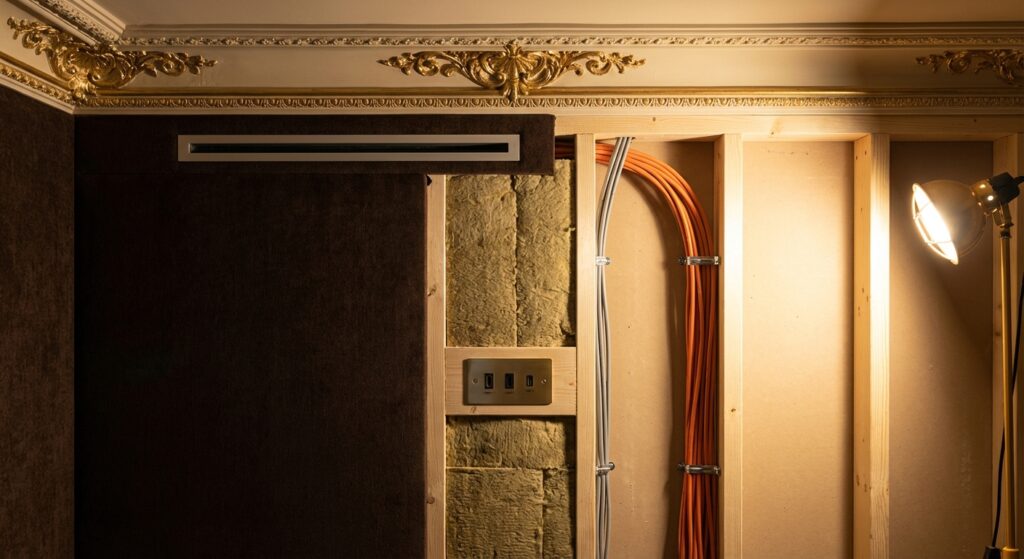
Modenese manufactures stretched-fabric wall panels using a 52 mm deep timber batten frame constructed from kiln-dried poplar at 8 to 10% moisture content, compliant with EN 942 joinery timber grading. The infill layer uses 75 mm acoustic mineral wool at 60 kg/m³ density, which achieves a noise reduction coefficient (NRC) of 0.92 at 1,000 Hz when tested per ASTM C423. The facing fabric is a woven chenille or velvet in weights between 380 g/m² and 520 g/m², selected for acoustic transparency at mid and high frequencies while providing the visual warmth of upholstered plaster-era interiors.
Within this assembly, all electrical conduit for HDMI 2.1 runs (48 Gbps bandwidth, supporting 8K at 60 Hz uncompressed), low-voltage lighting circuits, speaker cable, and Crestron control wiring terminate at flush-mounted brushed brass plates custom-machined to match period hardware. The total wall assembly adds 97 mm to the room perimeter when including a 45 mm services void behind the batten frame. For a standard 60 m² cinema room with a 24-linear-metre perimeter, this reduces usable floor area by 2.33 m², a trade-off Modenese documents in pre-construction acoustic modeling delivered to clients before frame installation begins.
Ventilation Concealment and Thermal Performance
Projector cooling at the 2,400 W dissipation level requires a minimum airflow of 820 m³/h at 25 Pa static pressure, with a noise floor of 35 dB(A), acceptable for cinema use. Modenese integrates slot diffusers with 150 mm x 25 mm apertures behind continuous fabric fascias at cornice level, spaced at 600 mm centers along the projection wall. The slot geometry is calculated to limit air velocity to 0.8 m/s at the face, preventing audible turbulence noise. Ductwork transitions from a round section to a rectangular flat duct (500 mm x 100 mm) within the ceiling void to maintain ceiling height while clearing structural beams.
Bespoke Recliner Seating: Technical Specification
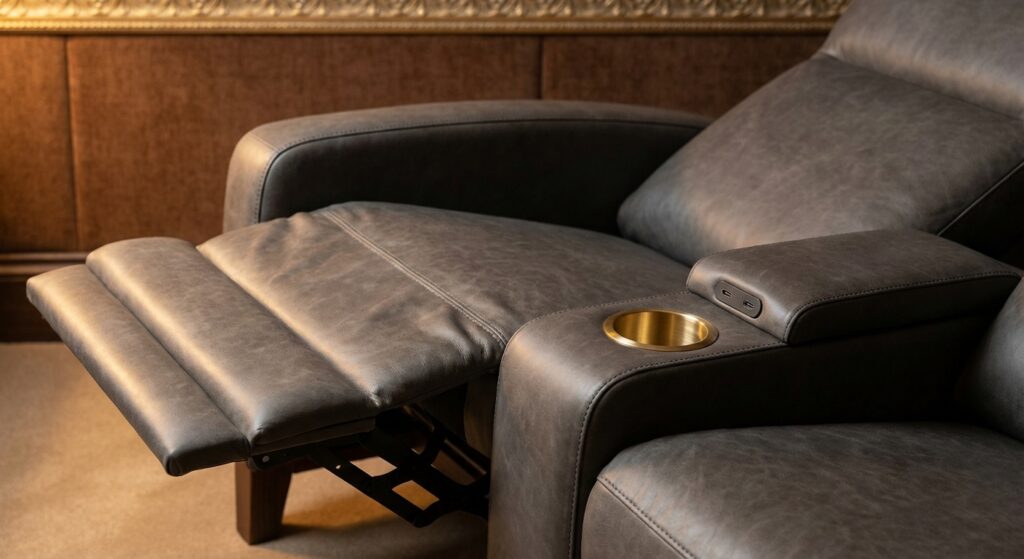
The seating product that Modenese positions as central to the invisible cinema concept is a fully bespoke electric recliner manufactured on a solid beech frame, 42 mm section, with eight-way hand-tied spring suspension at the seat deck rated to 180 kg static load per unit. The recliner mechanism is a German-engineered linear actuator producing 180 degrees of recline travel from 108-degree upright to 15-degree near-flat, with positioning accuracy to 1-degree increments via the companion app or Crestron integration. Motor noise is rated at 38 dB(A) at 1 metre, below the ambient noise floor of the room during playback.
Upholstery uses full-grain aniline leather sourced from Italian tanneries in the Santa Croce sull’Arno district, available in premium grey (designation PG-17) and dark tobacco brown (designation TB-22), both finished at 1.0 mm to 1.2 mm thickness with a pull-up wax finish that shows surface character without synthetic coating. Seat depth measures 640 mm, seat width 740 mm, and overall height in upright position 1,120 mm. The footrest extension adds 480 mm when fully deployed. A two-seat module measures 1,680 mm wide with a fixed centre console housing two USB-C charging ports rated at 60 W each and a concealed cold-brew cup holder with 85 mm diameter aperture.
Pricing for the bespoke recliner in standard leather configuration begins at EUR 8,400 per seat, with custom embroidery, alternative hides, or power headrest additions priced on project specification. Lead time from confirmed order to delivery runs 14 to 18 weeks for GCC destinations including Bahrain and 10 to 12 weeks for UK delivery, reflecting local customs classification under HS code 9401.40 for seating with supporting mechanisms.
8K Display and Projection: Technical Constraints in Period Rooms
The ITU-R BT.2020 color standard governing 8K production and display defines a color gamut covering 75.8% of the CIE 1931 color space, compared to 53.6% for the earlier BT.709 standard used for 1080p content. Achieving this gamut in a room with warm-toned fabric wall panels requires projector calibration, accounting for reflected ambient light with a correlated color temperature between 2,700 K and 3,200 K from period-style tungsten-equivalent lighting. Details on the ITU-R BT.2020 specification are published directly by the International Telecommunication Union.
Screen gain selection is critical in warm-reflective environments. A standard 1.0 gain white screen reflects approximately 20% of ambient room light back toward the audience in a room with NRC 0.35 surfaces (typical of decorated plaster). After Modenese’s fabric panel installation raises the effective NRC to 0.78 to 0.85, ambient light scatter drops by 62%, allowing the use of a 0.9 gain grey screen that improves contrast ratio without sacrificing on-axis brightness. Recommended screen diagonal for rooms between 7 m and 10 m throw distance is 120 inches to 150 inches (3,048 mm to 3,810 mm), maintaining a viewing angle below 35 degrees from the front-row recliner centerline.
Projector placement in period ceilings requires custom ceiling mounts with adjustable drop rods between 300 mm and 1,200 mm to position the lens center at 60% of screen height above the floor. For a 150-inch 16:9 screen with a bottom edge at 900 mm AFF (above finished floor), screen height is 1,869 mm, and lens center target is 2,021 mm AFF. This typically positions the projector body within the period cornice zone, requiring custom plaster niches or fully concealed ceiling coffers lined with velvet-backed panels to prevent heat buildup.
Smart Home Automation Architecture for Mansion-Scale Installations
Bahrain and London mansion projects differ in automation infrastructure requirements due to mains voltage standards (230 V / 50 Hz in Bahrain; 230 V / 50 Hz UK ring main) and grid reliability. Bahrain installations in Riffa and Amwaj Islands districts typically require UPS backup rated at 10 kVA for the AV and lighting control systems, given grid fluctuation events averaging 14 per year as reported by regional facility managers. London Grade II-listed projects face additional constraints under conservation area conditions, restricting penetrations through original masonry, requiring all conduit runs to use existing chimney voids and floor voids as service routes.
Crestron Home OS 3, the current platform of choice for mansion-grade projects, supports up to 100 rooms and 1,000 controllable devices per processor, with response latency below 200 milliseconds for lighting scenes and sub-50 milliseconds for audio routing commands. The smart home market for automation at this specification level is growing: Statista projects global smart home revenue to reach USD 222.9 billion by 2027, with residential AV integration representing approximately 19% of segment revenue. Modenese coordinates with certified Crestron programmers in both the GCC and UK, delivering single-app control of cinema scenes, curtain motors, HVAC zones, and fragrance diffusion from a Crestron TSW-1060 touchscreen or iOS/Android companion interface.
Acoustic Certification Standards and Measurement Protocol
A completed Modenese invisible cinema installation is measured against three benchmarks before client handover. First, the RT60 at 500 Hz and 1,000 Hz must be below 0.35 seconds in the furnished room. Second, the noise criterion (NC) curve for the HVAC system must fall below NC-25, equivalent to approximately 35 dB(A) steady-state background noise. Third, flanking sound transmission through the wall assemblies must not exceed 35 dB SPL in adjacent rooms when measured during a reference 85 dB SPL cinema playback test signal.
These metrics align with published recommendations from the NIST Building Environment Division on indoor acoustic performance in residential buildings. Measurement is conducted using a Class 1 sound level meter positioned at the primary listening position (3.4 m from screen center in a standard 8 m room) and at three secondary positions covering the full seating area width. Acoustic reports are delivered in PDF format with frequency-dependent RT60 plots and NC curves as project closeout documentation.
Material Comparison: Concealment Panel Systems by Specification
| Specification | Modenese Fabric Wall System | Standard GRG (Glass-Reinforced Gypsum) | Perforated MDF Panel |
|---|---|---|---|
| NRC at 1,000 Hz | 0.92 | 0.05 to 0.10 | 0.55 to 0.70 |
| Panel depth (mm) | 52 (batten frame only) | 18 to 25 | 22 |
| Services void behind (mm) | 45 | None standard | None standard |
| Visual finish options | Unlimited fabric selection | Paint only | Paint, veneer |
| Compatible with period architecture | Yes, with custom molding integration | Yes | Limited |
| Installed cost per m² (EUR) | 420 to 680 | 95 to 140 | 110 to 185 |
| HVAC slot integration | Yes, at 150 x 25 mm slot spec | Custom only, at added cost | Not standard |
Electrical and Signal Infrastructure for 8K Routing
HDMI 2.1 at full 48 Gbps bandwidth requires a cable rated to the Category 3 HDMI specification, with a maximum passive run length of 3 m to 5 m before signal integrity degradation. In a cinema room where the projector and AV rack are separated by 8 m to 15 m, an active optical HDMI cable (AOC) is mandatory, typically at 25 m or 50 m standard reel lengths, with a fibre-optic core diameter of 50/125 micron multimode OM3. All signal runs in Modenese installations use metal conduit with a minimum 20 mm inside diameter, maintaining a 200 mm separation from the 230 V power conduit to prevent electromagnetic interference that would appear as visible noise patterns on 8K content.
Audio distribution uses the Dante AV-H network protocol over Cat6A S/FTP cable rated to 10 Gbps at 100 m, connecting a central Dante-enabled processor to in-wall and in-ceiling speakers without analogue cable runs exceeding 3 m from the network node to the driver. This architecture supports Dolby Atmos configurations with up to 24 bed channels and 10 height channels, exceeding the 7.1.4 standard common in residential cinema but appropriate for rooms above 90 m³ volume.
Project Case Parameters: Bahrain Villa and London Townhouse
A representative Bahrain villa project in the South Riffa district includes a 68 m² dedicated cinema room with a ceiling height of 4.8 m, a stone floor finished in Bianco Sivec marble at 20 mm thickness, and an existing cornice depth of 380 mm, providing concealment depth for four ventilation slot assemblies. Total fabric wall panel installation covers 84 linear metres at an average panel height of 3.6 m, for a total of 302 m² of treated surface area. The Modenese recliner configuration in this room runs to three rows of two seats each, for a total of six units, totalling EUR 50,400 in the standard PG-17 grey leather specification.
A London Kensington townhouse project applies the same acoustic methodology to a 42 m² room with a 3.9 m ceiling height, with the additional constraint of Grade II listed building status prohibiting any fixings into the original lath-and-plaster ceilings. Modenese addresses this by suspending the entire acoustic ceiling structure on a freestanding steel frame bearing onto the floor structure at column points specified by a structural engineer, with no penetrations into protected fabric. The suspended ceiling incorporates 150 mm acoustic mineral wool at 45 kg/m³ and drops the effective ceiling to 3.4 m, within the recommended maximum for the 120-inch screen size used at this room depth. Academic research on acoustic treatment density and room response is published through the Journal of the Acoustical Society of America, which documents the relationship between absorption coefficient and RT60 reduction in small room applications.
Summary Specification Table: Invisible Cinema Integration at Mansion Scale
| System | Specification | Performance Target |
|---|---|---|
| 8K Display | 7,680 x 4,320 px, BT.2020 color gamut, 25,000 ANSI lm | 75.8% CIE 1931 coverage, CR > 1,800:1 on screen |
| Acoustic Wall Panels | 52 mm frame, 75 mm mineral wool at 60 kg/m³, NRC 0.92 | RT60 < 0.35 s at 500 Hz and 1,000 Hz |
| Ventilation | 150 x 25 mm slots at 600 mm centers, 820 m³/h airflow | NC-25 or better, face velocity 0.8 m/s |
| Recliner Seating | Solid beech, 180 kg rated, full-grain aniline leather 1.0-1.2 mm | 180-degree travel, 38 dB(A) motor noise |
| Signal Routing | HDMI 2.1 AOC 48 Gbps, Dante AV-H Cat6A at 10 Gbps | 8K@60 Hz uncompressed, Dolby Atmos 24.10 channel |
| Automation | Crestron Home OS 3, up to 1,000 devices | <200 ms scene response, unified iOS/Android control |
| Modenese Recliner Price | EUR 8,400 per seat (standard leather) | 14-18 weeks GCC, 10-12 weeks UK delivery |