Roche Bobois and the French Counterargument: Why Commissioning Artists Is a Design Strategy, Not a PR Move
Roche Bobois operates 266 stores across 56 countries and generated retail sales of EUR 499 million in 2024, making the French house one of the largest single-brand luxury furniture retailers in the world. The Roche Bobois design model differs fundamentally from the Italian craft-genealogy tradition: rather than building collections around workshop heritage, Roche Bobois commissions external artists, fashion designers, and architects to create original furniture. Missoni, Jean Paul Gaultier, Kenzo Takada, Ora Ito, Christian Lacroix, Sonia Rykiel, Pedro Almodovar, and Joana Vasconcelos have all produced collections for Roche Bobois. The Roche Bobois showroom in Dubai, located on Sheikh Zayed Road in Al Barsha 1, presents the full range of these artist-commissioned collections in a market where both French and Italian design traditions are actively specified in residential projects.
How Did Roche Bobois Build a Design Model Based on Artistic Collaboration?
Roche Bobois was founded in Paris in 1960 when Philippe Roche, Francois Roche, Jean-Claude Chouchan, and Patrick Chouchan merged their businesses after meeting at the Copenhagen Furniture Fair. The founding decision that set Roche Bobois apart from Italian competitors was structural: Roche Bobois chose not to own manufacturing resources. Roche Bobois instead built a distribution-first business model, commissioning designers and external manufacturers to produce pieces exclusively for the Roche Bobois brand. The approach freed Roche Bobois to source creative talent from any discipline, not only from the furniture trade.
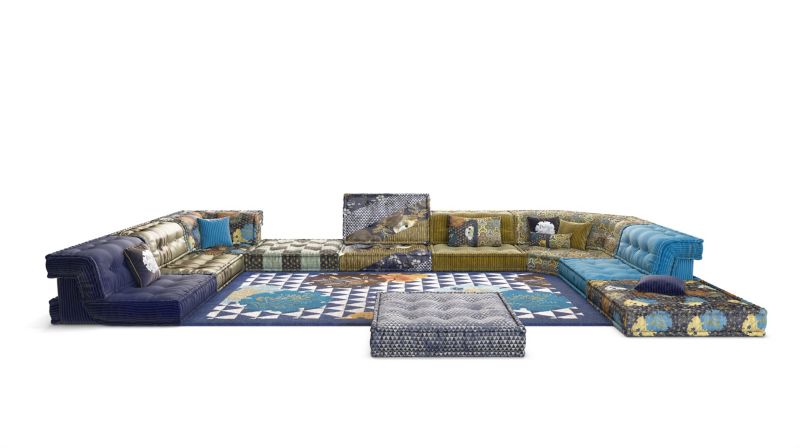
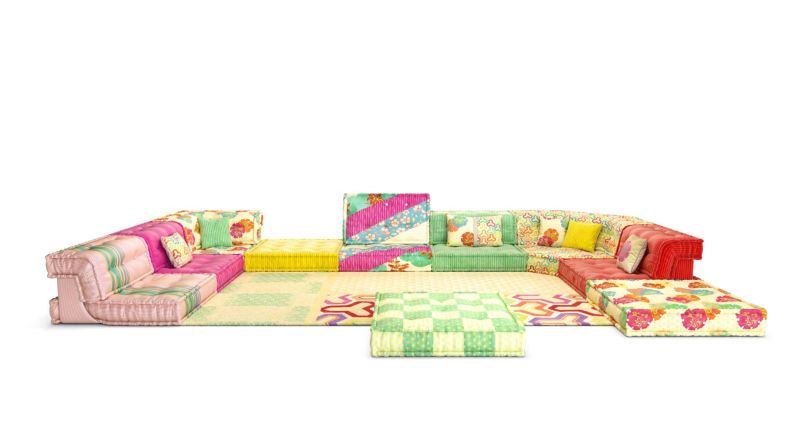
The first major collaboration that defined the Roche Bobois identity came in 1970, when Philippe Roche met German sculptor, painter, and designer Hans Hopfer during a trip to Germany. Hopfer designed the Mah Jong sofa in 1971, a modular floor-level seating system composed of three basic elements: a flat square cushion (95 x 95 cm), a backrest, and a corner section. The Mah Jong sofa’s modular structure allows owners to stack, align, and reconfigure the elements into anything from a single armchair to a full sectional or bed. The Mah Jong sofa has been the best-selling design in the Roche Bobois catalog since 1990, and it remains in continuous production more than 50 years after Hans Hopfer’s original design.
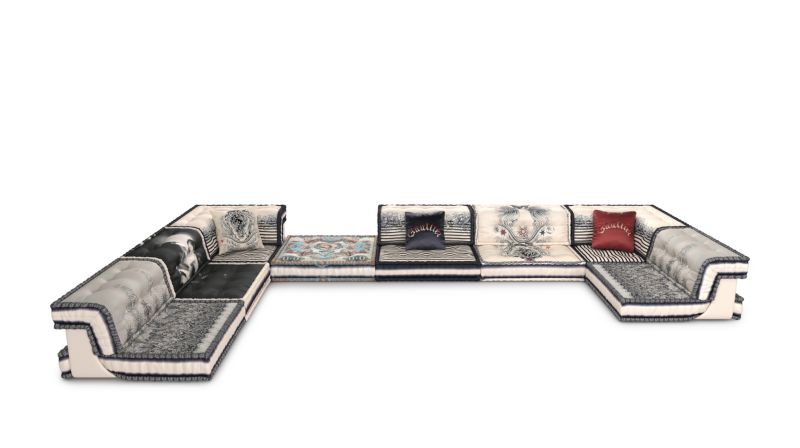
Each Mah Jong cushion is made entirely by hand in a dedicated workshop in Italy, using techniques borrowed from haute couture: hand-stitching, tufting, and layered padding. The Mah Jong sofa was originally named “Forever Sofa” before being renamed after the Chinese tile game, a reference to the way players form multiple configurations from a fixed set of pieces. The Roche Bobois strategy of inviting external creative talent to “dress” the Mah Jong in new fabrics, rather than redesigning the sofa itself, has turned the Mah Jong into a permanent platform for cross-disciplinary collaboration.
What Are the Major Roche Bobois Collaborations with Fashion Designers?
Roche Bobois has partnered with fashion houses and individual designers since the 1980s, producing limited and ongoing fabric collections that are applied to existing Roche Bobois furniture forms. The most significant Roche Bobois fashion collaborations include Missoni, Jean Paul Gaultier, and Kenzo Takada, each of whom brought a distinct visual language from the runway to the living room.
Jean Paul Gaultier and Roche Bobois: The 2010 Couture Collection
The Jean Paul Gaultier collaboration with Roche Bobois launched in 2010 to mark the brand’s 50th anniversary. Jean Paul Gaultier designed a full furniture collection for Roche Bobois that included the Mah Jong sofa in Couture fabric, the Armoire Paravent, a bust lamp, two limited-edition storage chests, the Dunkerque India rug, and the Ben Hur chair. Jean Paul Gaultier’s Roche Bobois Mah Jong features the designer’s signature sailor stripes, tattoo motifs, kitsch roses, and a romantic photograph juxtaposed across the modular cushions. Gaultier described the collaboration, saying he did not see himself as a furniture designer but as a fashion designer for whom dressing the home was a natural extension of dressing the body.
Kenzo Takada and Roche Bobois: The No Gaku Collection
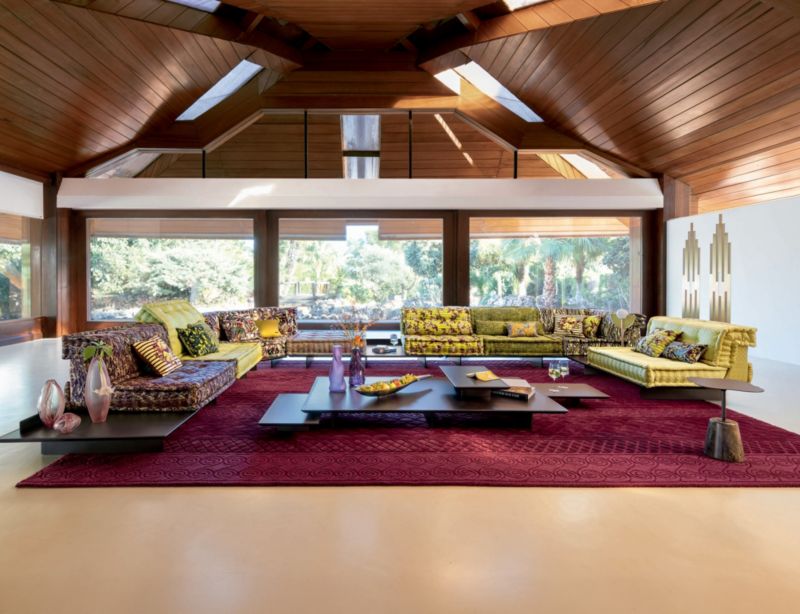
Kenzo Takada unveiled a collection of fabrics and ceramics for Roche Bobois in 2017. The Kenzo Takada collection for Roche Bobois, named No Gaku, drew inspiration from ancient kimonos used in Japanese Noh Theatre. Kenzo Takada reinterpreted patterns and colors from Noh costumes to create three distinct fabric harmonies symbolizing three times of day: Asa (morning), Hiru (midday), and Yoru (evening). The Mah Jong Umi composition by Kenzo Takada combines floral and geometric designs with ocean-inspired tones. Kenzo Takada also designed ceramics for the Roche Bobois collection, including the Hanazakari and Haru vases, each a red clay vase hand-turned and decorated with a lid knob made of multiple hand-assembled earthenware doves.
Kenzo Takada died on October 4, 2020, at the age of 81, from complications of COVID-19 at the American Hospital of Paris in Neuilly-sur-Seine. The Kenzo Takada collection for Roche Bobois remains in production as the last major furniture collaboration completed before Takada’s death. Roche Bobois continues to list Kenzo Takada as a partner designer alongside the brand’s other active collaborators.
Missoni and Roche Bobois: Ongoing Fabric Partnership
Missoni’s collaboration with Roche Bobois represents the longest-running fashion partnership in the Roche Bobois portfolio. Missoni provides fabric collections characterized by the Italian house’s zigzag patterns, color gradients, and woven textures for use on the Mah Jong sofa and other Roche Bobois upholstery. The Missoni-dressed Mah Jong sofa is one of the most frequently specified Roche Bobois configurations in Middle Eastern residential interiors, where the bold chromatic palette of Missoni fabrics complements large-format living spaces typical of Dubai villa design.
What Does the Ora Ito Collection Represent for Roche Bobois?
Ora Ito is a French designer born in 1977 who gained international attention in the late 1990s for unauthorized 3D reinterpretations of products from brands such as Louis Vuitton, Apple, and Nike. The Ora Ito dining table, designed for Roche Bobois in 2012, won the Red Dot Award “Best of the Best” in Product Design in 2014. The Ora Ito table is cantilevered on three twisting uprights that reference both plant forms and mechanical structures, reflecting Ora Ito’s design philosophy of “simplexity,” the art of giving a complex form the appearance of simplicity. A limited-edition bronze version of the Ora Ito table, produced in a run of 15 numbered pieces using lost-wax casting in an artisan workshop near Venice, was offered exclusively at La Galerie Roche Bobois in Monaco.
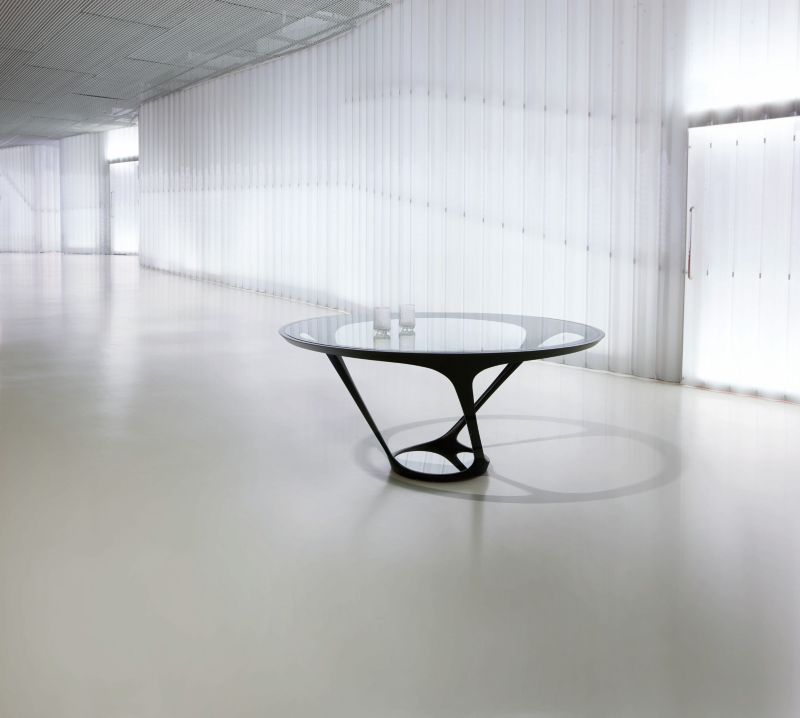
The Ora Ito collaboration illustrates how Roche Bobois extends its commissioning model beyond fashion: Ora Ito is not a furniture designer by training but a conceptual designer and digital artist. The full Ora Ito collection for Roche Bobois includes a high table, a low table, a sofa, a dresser, and a side table. Roche Bobois positions each Ora Ito piece as the work of an identified creative author, not as an anonymous product of a workshop tradition.
How Does the French Collaboration Model Differ from the Italian Craft-Genealogy Approach?
Italian luxury furniture brands, including Poltrona Frau, Cassina, B&B Italia, and Molteni&C, typically ground their authority in craft genealogy: multi-generational workshops, patented manufacturing processes, specialized materials, and long lineages of master artisans. Italian design authority is archived in the making. The cultural weight of an Italian sofa comes from how the leather was tanned, where the frame was joined, and which family has owned the workshop since the 1920s or 1950s.
The Roche Bobois model operates on a different axis of cultural authority. Roche Bobois draws legitimacy from the art and fashion worlds rather than from workshop lineage. When Roche Bobois puts Jean Paul Gaultier’s signature sailor stripes on the Mah Jong, the sofa acquires the cultural resonance of Gaultier’s career in haute couture. When Kenzo Takada translates Noh Theatre costumes into upholstery fabric, the Mah Jong sofa draws on a 600-year-old Japanese performance tradition. The cultural provenance of a Roche Bobois piece is not “made by the same hands that made your grandfather’s sofa.” The cultural provenance of a Roche Bobois piece is “conceived by the same mind that dressed Madonna for the Blond Ambition Tour.”
Neither model is superior. Both produce high-quality furniture with documented authorship. The distinction matters because buyers in Dubai’s luxury residential market regularly combine both traditions in a single interior scheme, and specifying effectively requires understanding the cultural weight each piece carries.
Why Does the French Collaboration Model Work in Dubai’s Luxury Residential Market?
Dubai’s luxury residential interiors function as composite environments. A typical high-end Dubai villa interior might combine Italian marble fabrication from a specialist fit-out contractor, German kitchen engineering from Gaggenau or Bulthaup, and furniture from both Italian craft houses and French design houses in the same living space. Roche Bobois performs well in this context because the brand’s collaboration model produces furniture that reads as cultural statement rather than craft object. A Kenzo Takada Mah Jong sofa placed alongside a B&B Italia sectional in a Dubai Palm Jumeirah villa does not create a conflict of design languages. The two pieces operate on different registers of authority: the B&B Italia piece speaks to material precision and manufacturing heritage; the Roche Bobois Kenzo Takada piece speaks to artistic vision and cross-cultural dialogue.
The Roche Bobois showroom in Dubai is located at the Hassanicor Building, ground floor, on Sheikh Zayed Road in Al Barsha 1. The Roche Bobois Dubai showroom carries both the Les Contemporains collection, which includes the brand’s artist-commissioned pieces, and the full range of Mah Jong configurations in Kenzo Takada, Jean Paul Gaultier, and Missoni fabrics. Dubai interior designers sourcing Roche Bobois through Solomia Home can access the full collection with the design consultation needed to integrate French collaboration pieces alongside Italian furniture without stylistic conflict.
Roche Bobois Global Presence and Financial Scale
| Metric | Figure | Period / Date |
|---|---|---|
| Total Roche Bobois stores worldwide | 266 (127 directly operated, 139 franchised) | December 31, 2024 |
| Countries of operation | 56 | June 2025 |
| Consolidated Group revenue | EUR 414 million | Full year 2024 |
| Roche Bobois brand retail sales (incl. franchises) | EUR 499 million | Full year 2024 |
| Q1 2025 directly operated store retail sales | EUR 108.7 million (record quarter, +6.1% YoY) | Q1 2025 |
| Order backlog | EUR 161.1 million | March 31, 2025 |
| Mah Jong sofa continuous production | Since 1971 (54+ years) | Ongoing |
| Mah Jong best-selling Roche Bobois sofa status | Since 1990 (35+ years) | Ongoing |
Roche Bobois opened new stores in Austin and Las Vegas in the United States and in Osaka, Japan during 2025. The Roche Bobois expansion strategy continues to prioritize markets where cross-cultural luxury consumption is established, including the Middle East, Asia, and North America.
Recent Roche Bobois Collaborations: Pedro Almodovar and Rossy de Palma (2025)
Roche Bobois unveiled a collaboration with Spanish filmmaker Pedro Almodovar at Milan Design Week 2025. The Almodovar collection for Roche Bobois includes a limited-edition reissue of the Lounge sofa, transformed into a graphic canvas reflecting Almodovar’s visual storytelling and color palette. Roche Bobois also produced a capsule collection with Rossy de Palma, the actress and longtime Almodovar collaborator, extending the collaboration into a two-artist dialogue. The Almodovar and de Palma collaborations demonstrate that the Roche Bobois commissioning model continues to expand beyond fashion into cinema, the visual arts, and performance.
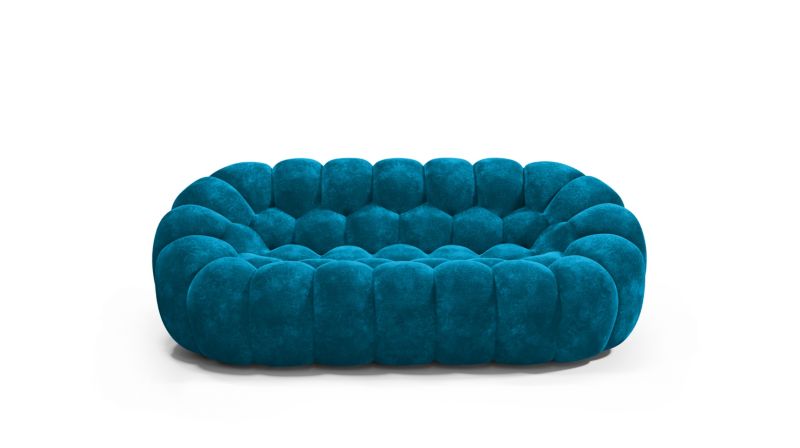
Sacha Lakic’s Bubble sofa, first produced by Roche Bobois in 2014, represents another facet of the Roche Bobois design commissioning approach. Sacha Lakic is a Serbian-French automotive and furniture designer whose primary work before Roche Bobois was in electric car design for Venturi. The Bubble sofa won the Luxembourg Design Awards Gold in Product Design in 2015. The Bubble sofa’s fabrication required the development of a proprietary stretch textile called Techno 3D, engineered to conform to the sofa’s organic, cloud-like geometry. The Bubble sofa is entirely handmade, structured with solid fir wood and pine plywood, and padded with bi-density HR foam.
Frequently Asked Questions
Where Is the Roche Bobois Showroom Located in Dubai?
The Roche Bobois showroom in Dubai is located at the Hassanicor Building, ground floor, on Sheikh Zayed Road in Al Barsha 1, Dubai, UAE. The Roche Bobois Dubai showroom is open seven days a week from 10:00 to 21:00 and can be reached by phone at (+971) 4 399 03 93 or by WhatsApp at +971 56 508 0510.
Who Designed the Roche Bobois Mah Jong Sofa?
German sculptor, painter, and designer Hans Hopfer designed the Mah Jong sofa for Roche Bobois in 1971. The Mah Jong sofa is a modular floor-level seating system composed of three basic elements (flat cushion, backrest, and corner section) that can be configured into virtually unlimited arrangements. The Mah Jong sofa has been the best-selling Roche Bobois design since 1990 and is currently available in fabrics by Kenzo Takada, Jean Paul Gaultier, and Missoni.
What Fashion Designers Have Collaborated with Roche Bobois?
Roche Bobois has collaborated with Jean Paul Gaultier (since 2010), Kenzo Takada (since 2017), Missoni (ongoing), Christian Lacroix, Sonia Rykiel, and Emanuel Ungaro. Roche Bobois also commissions architects and artists including Ora Ito, Sacha Lakic, Christophe Delcourt, Joana Vasconcelos, and Pedro Almodovar. The Roche Bobois collaboration model treats each external creative as an author whose vision is applied to Roche Bobois furniture forms.
Can Roche Bobois Furniture Be Combined with Italian Design in the Same Interior?
Roche Bobois furniture is regularly combined with Italian luxury furniture brands in Dubai residential interiors. The Roche Bobois collaboration model produces pieces that carry art-world and fashion-world cultural authority, while Italian brands like B&B Italia, Poltrona Frau, and Molteni&C carry craft-heritage authority. The two design traditions operate on different cultural registers and do not conflict when specified by a designer who understands the distinction between artistic provenance and manufacturing lineage.
Is the Kenzo Takada Collection Still Available at Roche Bobois Dubai?
The Kenzo Takada No Gaku collection remains in production and available for order at the Roche Bobois showroom in Dubai on Sheikh Zayed Road. The Kenzo Takada collection includes the Mah Jong sofa in three fabric versions (Asa, Hiru, and Yoru), the Mah Jong Umi ocean-toned composition, and a series of hand-decorated ceramics. Kenzo Takada died on October 4, 2020, at the age of 81, and the Roche Bobois Kenzo Takada collection represents the last major furniture collaboration completed before Takada’s death.